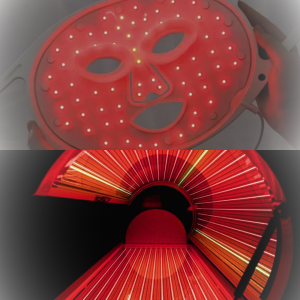
Traditional treatments for Parkinson’s Disease (PD) have largely been limited to symptomatic therapies centered on dopamine supplementation, offering little in the way of halting the fundamental progression of the disease. Recently, the medical science community has turned its attention to Whole-Body Photobiomodulation (Whole-Body PBM) therapy—an approach that goes beyond localized brain interventions to target systemic metabolic regulation and neuroinflammation.
This article provides an in-depth examination of the innovative therapeutic mechanisms through which Whole-Body PBM acts on the pathophysiology of Parkinson’s Disease, from a medical science perspective.
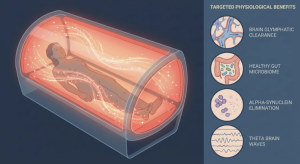

Understanding Whole-Body PBM Therapy
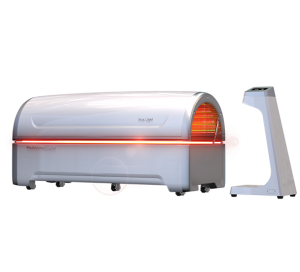
1. Cellular-Level Mechanisms of Whole-Body PBM
Photobiomodulation (PBM) is a non-invasive therapy that irradiates biological tissues with red and near-infrared light, primarily in the 600–1000 nm wavelength range.
The delivered light energy activates Cytochrome c oxidase (CCO) within the mitochondria of cells.
This, in turn, significantly increases the production of ATP—the cell’s primary energy source—and modulates reactive oxygen species (ROS).
Furthermore, it induces the release of nitric oxide (NO), which improves blood flow, thereby establishing a foundational metabolic environment for neuroprotection and regeneration.
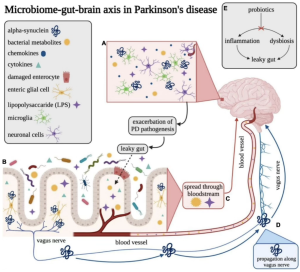
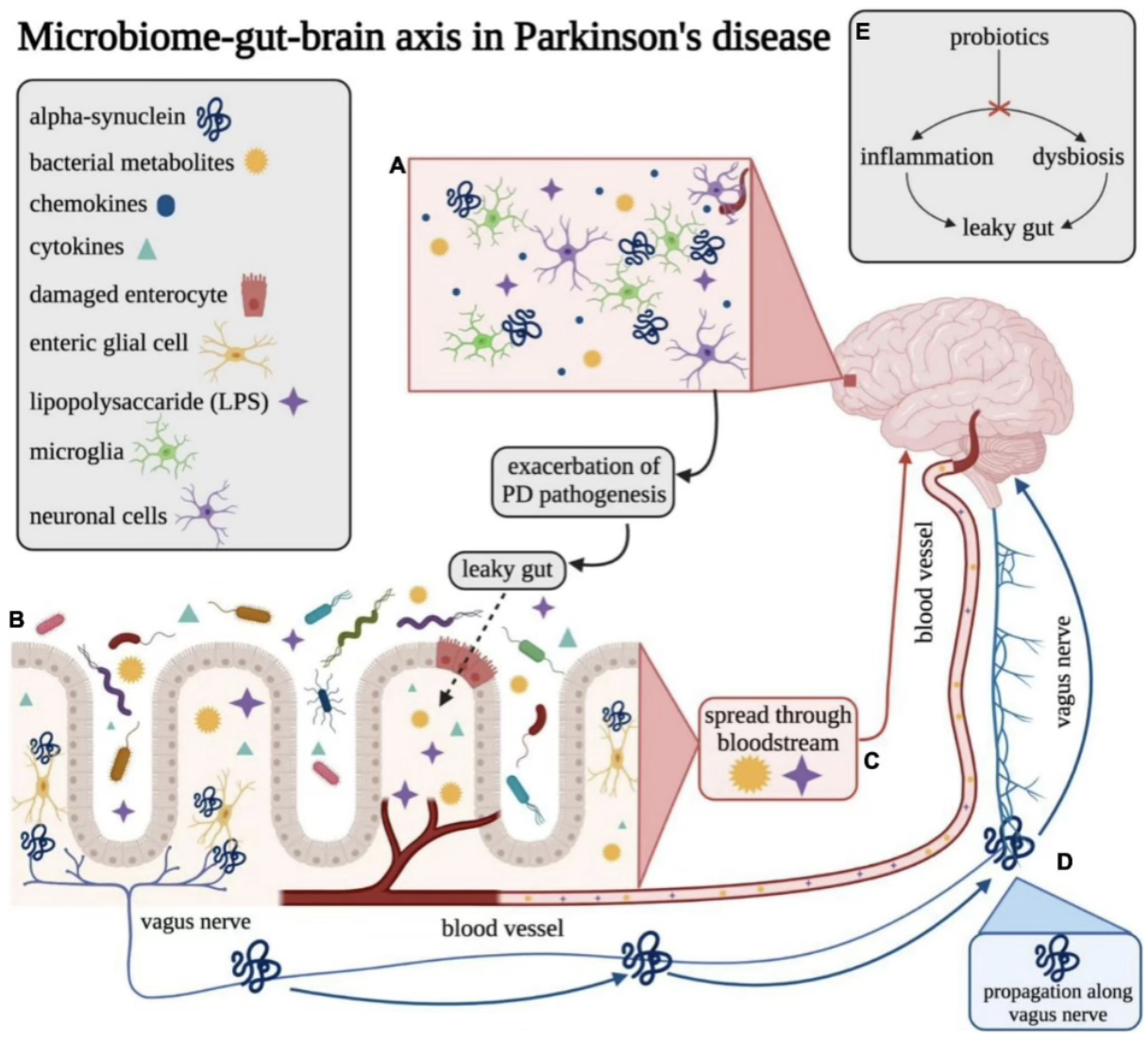
Figure 1. Interactions via the Gut-Brain Axis and the Pathological Mechanisms of Parkinson’s Disease
2. Improving the Gut-Brain Axis Based on the Braak Hypothesis
The “Braak Hypothesis,” which posits that Parkinson’s Disease pathology originates in the gut, has become a widely accepted theory.
Gut microbiome dysbiosis abnormally increases intestinal permeability, triggering systemic inflammatory responses and neuroinflammation in the brain.
When applied to the entire body, including the abdomen, Whole-Body PBM promotes the proliferation of beneficial bacteria (such as Bifidobacterium and Lactobacillus) while suppressing harmful bacteria, thereby restoring microbiome balance.
Clinical findings have confirmed that gut microbial diversity in patients recovers to levels comparable to those of healthy controls following PBM treatment, which reduces inflammation in the Enteric Nervous System.
The restored gut environment promotes the production of short-chain fatty acids (SCFAs), which strengthens the Blood-Brain Barrier (BBB) and exerts a powerful neuroprotective effect.
3. Inhibition of Alpha-Synuclein Aggregation and Blockade of Pathological Propagation
The abnormal aggregation of alpha-synuclein—the core component of Lewy bodies—and its ascending propagation via the vagus nerve represent key pathological hallmarks of Parkinson’s Disease. Whole-Body PBM addresses this through multifaceted mechanisms:
- Mitochondrial Function Restoration: By normalizing energy metabolism, PBM corrects protein misfolding errors and preemptively prevents aggregation.
- Autophagy Activation: PBM induces autophagy—the cell’s intrinsic cleanup mechanism—to promote the degradation of pre-existing alpha-synuclein aggregates.
- Neuroinflammation Suppression: By inhibiting the overactivation of microglia, PBM reduces the secretion of pro-inflammatory cytokines and mitigates neurotoxicity.
4. Enhanced Brain Detoxification Through Increased Glymphatic System Flow

Figure 2. The Glymphatic System Activated During Sleep and the Brain Waste Clearance Mechanism
The glymphatic system is a drainage pathway unique to the central nervous system that clears metabolic waste from brain tissue into the venous system through the exchange of cerebrospinal fluid (CSF) and interstitial fluid (ISF). In Parkinson’s Disease patients, this function is impaired, accelerating the accumulation of toxic proteins.
Whole-Body PBM therapy enhances cerebrovascular pulsatility.
It optimizes the aquaporin-4 (AQP4) water channel function of astrocytes, significantly increasing glymphatic flow.
This facilitates the effective clearance of accumulated alpha-synuclein and beta-amyloid.
5. Clinical Significance of Theta Waves and Sleep Induced During Treatment
A notable neurophysiological change observed in clinical settings during Whole-Body PBM therapy is the shift in brainwave (EEG) activity during the 20-minute treatment session. Starting from beta waves in the waking state, the brain transitions through alpha waves (relaxation) and enters the theta wave (4–8 Hz) range, associated with deep meditation and sleep.
- Maximizing Glymphatic Clearance Efficiency: Along with theta wave induction, patients typically fall into a deep sleep lasting approximately 10 minutes. During this period, the intercellular spaces in the brain expand, and waste clearance efficiency surges by more than 60% compared to the waking state.
- Enhancing Neuroplasticity: The theta wave state activates hippocampal function, contributing to cognitive performance and memory consolidation.
💡 Conclusion and Clinical Recommendations
Numerous recent clinical studies have demonstrated that Whole-Body PBM therapy not only alleviates motor symptoms of Parkinson’s Disease (tremor, rigidity, bradykinesia) but also produces significant improvements in non-motor symptoms such as cognitive decline, depression, and sleep disorders.
Whole-Body Photobiomodulation (PBM) therapy is not merely a symptom suppressant. Through mitochondrial metabolic activation, normalization of the gut-brain axis microbiome, and enhancement of glymphatic system detoxification mediated by sleep, it represents a non-invasive and highly promising therapeutic paradigm that addresses the root causes of the disease.
References
- Liebert, A., et al. (2021). “Remote Photobiomodulation Treatment for the Clinical Signs of Parkinson’s Disease: A Case Series.” Photobiomodulation, Photomedicine, and Laser Surgery.
- Bicknell, B., et al. (2022). “Microbiome Changes in Humans with Parkinson’s Disease after Photobiomodulation Therapy: A Retrospective Study.” Journal of Personalized Medicine.
- Foo, A. S. C., et al. (2020). “Photobiomodulation: A Potential New Treatment for Parkinson’s Disease.” International Journal of Molecular Sciences.
- Zinchenko, E., et al. (2019). “Photobiomodulation of the glymphatic system: A new perspective in Alzheimer’s and Parkinson’s disease treatment.” Journal of Biophotonics.
- Xie, L., et al. (2013). “Sleep drives metabolite clearance from the adult brain.” Science.
- Hamilton, C., et al. (2022). “Lights at night: does photobiomodulation improve sleep?” Neural Regeneration Research.
- Salehpour, F., et al. (2018). “Brain Photobiomodulation Therapy: a Narrative Review.” Molecular Neurobiology.
- Sledge, H. (2025). “Is light therapy the new frontier in Parkinson’s treatment?” NR Times.
- Hamblin, M. R. (2016). “Photobiomodulation or low-level laser therapy.” Journal of Biophotonics.
- El Khoury, H., et al. (2019). “Gut-Brain Axis: The Role of the Gut Microbiota in Parkinson’s Disease.” Frontiers in Clinical Neuroscience.