
PEMF Bone Health: Can Bone-Forming Cells Become Fat With Age?
PEMF and bone health are usually discussed in terms of bone formation, healing, or bone density. But a 2025 study raised a much stranger question: what happens when aging bone marrow begins favoring fat formation over bone formation?
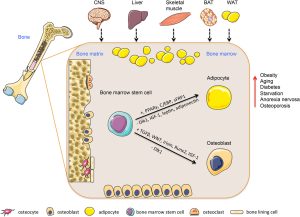
As we age, bone does not simply become thinner. Inside the marrow, mesenchymal stem cells can also shift away from an osteogenic, bone-forming fate and toward adipocytes, or fat cells.
Researchers publishing in Nature Communications investigated whether PEMF, or pulsed electromagnetic fields, could influence that cellular balance.
Why Does Fat Increase in Aging Bone Marrow?
Bone marrow contains mesenchymal stem cells, or MSCs.
These cells are multipotent, meaning they are capable of developing along several different lineages.
Two of those pathways are especially relevant here.
They can move toward an osteogenic pathway, eventually contributing to bone-forming osteoblasts.
Or they can move toward an adipogenic pathway and become adipocytes, or fat cells.
With aging, the bone marrow environment can increasingly shift toward adipogenesis.
In simple terms:
The balance can begin moving away from making bone and toward making fat.
This is why aging bone is more complex than simply “losing bone mass.”
The cellular environment itself is changing.
And that leads to an intriguing question:
Could an external physical signal push that balance in another direction?
What Did the 2025 PEMF Study Find?
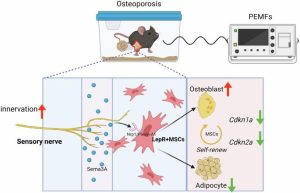
In the 2025 Nature Communications study, researchers applied PEMF stimulation to aged male mice.
They reported several notable changes in the PEMF-treated animals:
- increased new bone formation
- increased osteogenesis
- reduced bone marrow adipogenesis
- increased innervation within bone
At first, this might sound like a straightforward PEMF bone health finding.
PEMF was applied, and bone formation increased.
But the researchers did not stop there.
They wanted to understand how it was happening.
And that is where the study became much more interesting.
When sensory nerve function was disrupted, the bone-forming effect of PEMF disappeared.
That finding changed the story.
This was no longer just about electromagnetic fields acting on bone cells.
The nervous system was involved.
Sema3A and Nrp1: The Bone-Nerve Signaling Pathway
Most of us do not think about nerves when we think about bone health.
But bone is heavily connected to the nervous system.
Sensory nerve fibers extend throughout bone tissue and participate in signaling between the nervous system and the local bone environment.
In this study, researchers identified a key signaling molecule called Sema3A, or semaphorin 3A.
Following PEMF stimulation, sensory nerves released Sema3A.
That signal then interacted with Nrp1, or neuropilin-1, on mesenchymal stem cells inside the bone marrow.
The pathway can be simplified like this:
PEMF –> Sensory nerve response –> Sema3A –> Nrp1 on mesenchymal stem cells –>
Bone formation↑ / Fat formation↓
A physical electromagnetic signal triggered a nerve-related response, and that response was connected to the developmental direction of stem cells inside bone marrow.
That is the finding that makes this study so compelling.
Why Were Sensory Nerves Essential?
It would be easy to summarize the paper as:
PEMF increased bone formation.
But that misses the most important part.
The researchers found a connection between:
physical stimulation, sensory nerves, cellular signaling, and stem-cell fate.
The mesenchymal stem cells were not simply reacting directly to an electromagnetic field in isolation.
The surrounding biological network mattered.
When sensory nerve function was removed, the PEMF-related bone-forming effect was also lost.
That suggests that the body was interpreting the physical signal through a biological communication pathway.
And that gives us a very different way to think about PEMF.
What Does This Mean for PEMF and Bone Health?
We usually think of bone like the frame of a building.
But living bone is constantly changing.
Bone tissue is continuously formed, broken down, and remodeled.
Inside it are:
- blood vessels
- sensory nerves
- bone marrow
- immune cells
- stem cells
- osteoblasts
- osteoclasts
- signaling molecules
All of these systems communicate.
So bone health is not only about how much calcium is present.
It is also about the biological environment telling cells:
what to do next.
That is why this PEMF bone health study is interesting.
It adds another layer to the way we think about aging bone.
Nutrition matters.
Hormones matter.
Mechanical loading matters.
But signals matter too.
Why This Research Is Relevant to Wave Motion
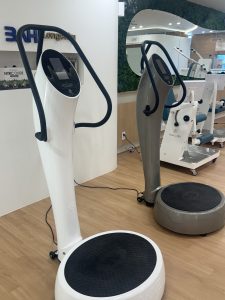
At Hue Light, we work with a technology called Wave Motion.
When people first see Wave Motion, they may assume it is simply a vibration platform.
But Wave Motion is designed around two different forms of physical input.
PEMF
Pulsed electromagnetic fields
Electromagnetic input
Sonic Sound Wave
Acoustic and mechanical wave stimulation
Acoustic-mechanical input
In other words, Wave Motion does not rely on movement alone.
It combines PEMF with sonic sound wave stimulation within the same system.
That distinction matters because the 2025 study gives us an interesting example of what physical signaling can mean biologically.
An electromagnetic input did not simply produce a mechanical sensation.
It was associated with a sensory nerve response that then connected with stem-cell behavior.
“How Much Does It Vibrate?” May Be the Wrong Question
When looking at a movement-based device, the most obvious question is usually:
How strongly does it move?
But with Wave Motion, there is another question worth asking:
What types of physical signals are actually reaching the body?
Wave Motion combines:
PEMF → electromagnetic signaling
and
Sonic Sound Wave → acoustic-mechanical signaling
Those are two different forms of physical input.
That is why describing Wave Motion simply as a vibration device misses part of what the system is designed to do.
Its underlying concept is closer to dual physical-signal stimulation.
Recovery Science Is Looking Beyond What We Put Into the Body
When we think about changing the body, we usually think about things we consume or physically do.
Food.
Supplements.
Medication.
Exercise.
But cells also live inside a physical environment.
The body continually detects:
- mechanical load
- pressure
- temperature
- light
- sound
- electromagnetic fields
Research is increasingly exploring how these different physical inputs interact with biological signaling pathways.
The 2025 PEMF study provides an especially striking example.
The researchers began with an electromagnetic field.
But what they ultimately uncovered involved:
sensory nerves → signaling molecules → stem cells → bone versus fat formation.
That is a much more sophisticated biological story than simply saying:
“PEMF stimulates bone.”
So, Do Bone-Forming Cells Actually Turn Into Fat?
Not exactly.
Bone cells themselves do not simply transform into fat cells.
The more accurate explanation is that mesenchymal stem cells inside bone marrow can differentiate toward either osteogenic or adipogenic lineages.
With aging, that balance can increasingly favor adipogenesis.
In the 2025 study, PEMF exposure in aged male mice was associated with:
increased osteogenesis and decreased adipogenesis.
Sensory nerve signaling through the Sema3A-Nrp1 pathway appeared to be essential to that response.
So perhaps the most important takeaway from this research is not simply about PEMF.
It is about bone itself.
Bone is not just a structure that gradually becomes weaker with age.
It is living tissue.
It receives signals.
Its nerves communicate.
Its stem cells make decisions.
And those decisions can influence whether the surrounding environment favors bone formation or fat formation.
The more we understand those signals, the more interesting the future of PEMF and physical-signal-based recovery science becomes.
Reference
Pulsed electromagnetic fields mediate sensory nerve regulation for bone formation in aging models.
Nature Communications. 2025.
https://www.nature.com/articles/s41467-025-63703-9