
What Happened in an Oncology Ward in 2017
Up to 80% of patients receiving radiation therapy for head and neck cancers develop oral mucositis during treatment — a condition in which the mucosal lining of the mouth breaks down so severely that swallowing becomes impossible. For some patients, the pain is intolerable enough to abandon chemotherapy altogether.
In 2017, following the publication of pivotal Phase III clinical results, the Multinational Association of Supportive Care in Cancer and the International Society of Oral Oncology (MASCC/ISOO) updated their official clinical guidelines with a new recommended intervention. The medical community took notice.
The intervention was light — a specific wavelength of it.
That same year, Professor Michael Hamblin of Harvard Medical School’s Wellman Center for Photomedicine summarized the state of the field:
“Photobiomodulation is no longer in the realm of alternative therapy. It is a validated biomedical intervention grounded in cellular bioenergetics.”
The technology is called Photobiomodulation — PBM.
Why PBM Can Actually Repair Cells
Dermatology lasers, germicidal UV, thermal infrared — light-based technologies are already widespread. So what makes PBM different?
Red light (630–700 nm) within the visible spectrum, and near-infrared light (700–1100 nm) beyond what the eye can see, do not simply reflect off or absorb into the skin’s surface. They penetrate deep into tissue — and once inside the cell, they interact with a specific protein.
That protein is Cytochrome C Oxidase (CCO).
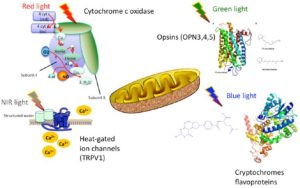
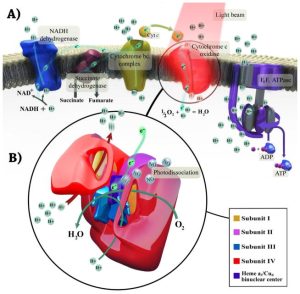
Located on the inner mitochondrial membrane, CCO is the critical terminal enzyme of the electron transport chain — the biological machinery through which our cells use oxygen to produce ATP, the currency of cellular energy.
The problem: under conditions of stress, aging, disease, or toxic exposure, nitric oxide (NO) is overproduced and binds to CCO, blocking enzyme function. Like a factory line shutting down, cellular energy production halts.
PBM photons physically dissociate this NO from CCO. The blocked electron transport chain reopens, ATP synthesis normalizes, and the cell — now energized — begins repairing its own damage.
This is not heat. It is not a chemical reaction. It is photonic information translated into the language of the cell.
Why PBM Acts Across Such a Diverse Range of Conditions
A common question: “How can a single light therapy be relevant to cancer side effects, Parkinson’s disease, and diabetes?”
The answer is both simple and profound. PBM does not target a specific disease. It activates the recovery pathways that damaged cells universally share — regardless of the disease category.
Whether the underlying condition is cancer, neurodegeneration, or autoimmune disease, cellular energy depletion and oxidative stress are the common denominators at the cellular level. PBM acts on that shared root.
Five Clinically Documented Effects of PBM
1. Cellular Energy Restoration — Reigniting the Mitochondria
Mitochondrial function declines approximately 10% per decade beginning in the fourth decade of life. Chemotherapy toxicity, chronic inflammation, and neurodegeneration accelerate this decline further. When ATP production falls, cells lack the energy to repair themselves.
Red and near-infrared light directly stimulate this pathway, increasing ATP synthesis. This goes beyond fatigue recovery — it represents the restoration of fundamental cellular processes: cell division, protein synthesis, and DNA repair.
2. Chronic Inflammation Modulation — Not Suppression, But Regulation
PBM’s anti-inflammatory mechanism is fundamentally different from that of NSAIDs. Anti-inflammatory drugs suppress the inflammatory response itself. PBM, at the cellular signaling level, reduces the overproduction of pro-inflammatory cytokines (TNF-α, IL-6, IL-1β) while simultaneously upregulating anti-inflammatory mediators — a bidirectional regulation.
This distinction matters clinically. Broad immune suppression compromises infection defense. PBM, by contrast, preserves normal immune function while calming hyperactivated inflammatory signaling. This property has attracted significant attention for autoimmune disease management and whole-body inflammation support during oncology treatment.
3. Transcranial Photon Penetration — Light That Reaches the Brain
Among PBM’s most striking findings: near-infrared light in the 810–1064 nm range penetrates the skull and reaches brain tissue.
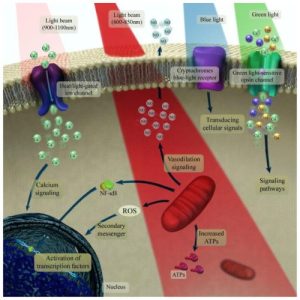
Photons that pass through the scalp, cranium, and meninges to reach the cerebral cortex stimulate neuronal mitochondria and increase secretion of neuroprotective factors — BDNF (brain-derived neurotrophic factor) and NGF (nerve growth factor). Damaged synaptic connections are restored, and neuroplasticity is enhanced.
In a clinical study of Parkinson’s disease patients (Liebert et al., 2021), combined transcranial, abdominal, and cervical PBM application produced statistically significant improvements in gait speed, balance, and cognitive function. Multiple trials investigating PBM’s role in post-stroke neurological recovery are ongoing.
4. Peripheral Nerve Regeneration and Microvascular Expansion — Recovery That Reaches the Extremities
Numbness in the hands and feet, sensitivity to cold floors, diminished sensation at the fingertips. Diabetic peripheral neuropathy and peripheral circulatory insufficiency carry different diagnoses but share the same underlying cause: impaired peripheral microvascular function and energy deficiency in peripheral nerve fibers.
PBM addresses both simultaneously. By inducing nitric oxide (NO) release from vascular endothelial cells, it promotes microvascular dilation. By reactivating mitochondria in peripheral neurons, it restores nerve conduction velocity.
In clinical trials of diabetic peripheral neuropathy, patients receiving low-level laser therapy demonstrated statistically significant improvements in both nerve conduction velocity and neuropathic symptom scores.
5. Oncology Side-Effect Care — The Light That Made the Guidelines
To return to where we began.
The reason MASCC/ISOO incorporated PBM into its clinical guidelines is straightforward: the data was sufficient. Long-term follow-up from a randomized Phase III trial in head and neck cancer patients showed that those who received PBM concurrently with chemoradiation therapy demonstrated meaningful results in oral mucositis prevention and treatment completion rates.
Evidence continues to accumulate across radiation dermatitis, post-chemotherapy lymphedema, and peripheral neuropathy. Oncology-context PBM requires professionally calibrated parameters tailored to lesion location and characteristics — clinical judgment is prerequisite.
Why This Technology Is Drawing Attention Now
PBM was first described in the 1960s. Why is mainstream science only now taking serious notice?
Two reasons.
First: technological maturity. Precisely controlling photonic delivery — the optimal combination of wavelength, irradiance, fluence, and exposure duration — required decades of engineering before it could be implemented at clinical-grade resolution. The gap between an inexpensive LED panel and a clinical-standard PBM device is built here.
Second: mechanistic clarity. That PBM produced effects had long been observed. What was incomplete until relatively recently was the cellular-level explanation of why. The convergence of mitochondrial biology, nitric oxide signaling research, and neuroplasticity science with PBM mechanisms has finally established the scientific foundation for clinical confidence.
This technology is not a wellness trend. It is at the frontier of life science, with the pace of validation accelerating.
Closing
Light is life’s first energy source. Just as plants convert light into chemical energy through photosynthesis, our cells are designed to respond to specific wavelengths of light. Leveraging this biological design — encoded through hundreds of millions of years of evolution — is why PBM is described as the closest thing to naturalistic cellular recovery.
Whatever state your cells are in today, the capacity for recovery already exists within them. Light is one way to turn that key.
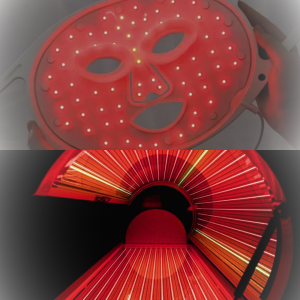
👉 Explore the Hue Light Whole-Body PBM Chamber
Disclaimer: The scientific literature cited on this site is provided for educational purposes only and does not constitute medical advice, diagnosis, or treatment. Consult a qualified healthcare professional before beginning any therapeutic protocol.
References
- de Freitas LF, Hamblin MR. Proposed Mechanisms of Photobiomodulation or Low-Level Light Therapy. IEEE J Sel Top Quantum Electron. 2016;22(3):7000417.
- Hamblin MR. Photobiomodulation or low-level laser therapy. J Biophotonics. 2016;9(11-12):1122–1124.
- Hamblin MR. Mechanisms and applications of the anti-inflammatory effects of photobiomodulation. AIMS Biophys. 2017;4(3):337–361.
- Salehpour F, et al. Brain Photobiomodulation Therapy: A Narrative Review. Mol Neurobiol. 2018;55(8):6601–6636.
- Liebert A, et al. Improvements in clinical signs of Parkinson’s disease using photobiomodulation: a prospective proof-of-concept study. BMC Neurol. 2021;21(1):256.
- Khamseh ME, et al. Diabetic distal symmetric polyneuropathy: Effect of low-intensity laser therapy. Lasers Med Sci. 2011;26(6):831–835.
- Antunes HS, et al. Long-term survival of a randomized phase III trial of head and neck cancer patients receiving concurrent chemoradiation therapy with or without low-level laser therapy (LLLT) to prevent oral mucositis. Oral Oncol. 2017;71:11–15.
- Zadik Y, et al. Systematic review of photobiomodulation for the management of oral mucositis in cancer patients and clinical practice guidelines. Support Care Cancer. 2019;27(10):3969–3983.