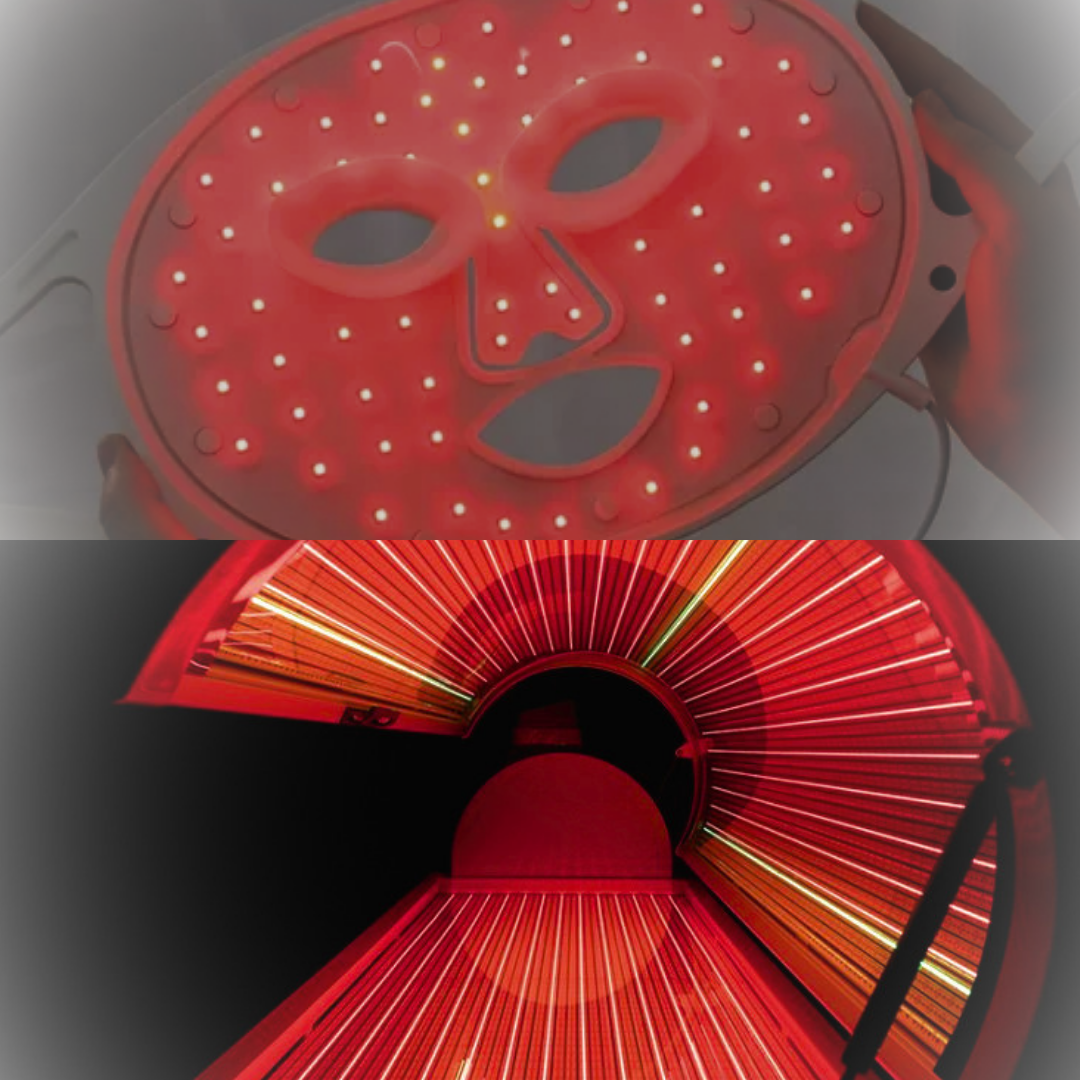
If you are comparing a red light mask vs whole-body PBM, the answer is not that one is simply better than the other.
They are designed for different treatment scopes.
A red light mask concentrates photobiomodulation on a clearly defined area: the face. Whole-body PBM is designed to expose much larger regions and a wider variety of tissues during the same session.
That difference matters because PBM is not determined by device size alone. Wavelength, irradiance, dose, treatment time, treatment area, distance, and pulse parameters can all change the exposure being delivered.
So the better question is:
Which PBM format matches the area and purpose I actually want to address?
Red Light Masks Are Specialized for Facial PBM
Red light masks have helped make photobiomodulation mainstream.

They are convenient, easy to use, and designed around one specific treatment area. For someone primarily interested in facial skincare, that specialization can be exactly what makes a mask useful.
A mask keeps the light source close to the face and simplifies positioning. Depending on the device, the light may be delivered using specific wavelengths, intensities, treatment times, or pulse patterns.
So a mask should not be viewed as a smaller or less sophisticated version of whole-body PBM.
It is a specialized delivery format for facial exposure.
Its treatment area is simply different.
And that distinction becomes important when PBM goals extend beyond the face.
Whole-Body PBM Is Designed for a Different Treatment Scale
Whole-body PBM addresses a different challenge:
How do you expose many regions of the body during the same session?
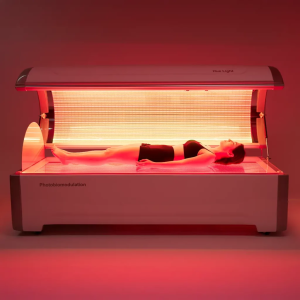
Instead of concentrating on the face or another selected area, a whole-body system can include the torso, back, arms, hips, thighs, legs, and large muscle groups within the treatment field.
That means substantially more than additional skin is exposed.
The treatment area may also include larger amounts of:
-
skeletal muscle
-
connective tissue
-
vasculature
-
metabolically active tissue
- multiple muscle groups simultaneously
This is the main reason whole-body PBM should not simply be thought of as a larger red light mask.
The treatment scale is different.
Why Treatment Area Matters in an Interconnected Body
The human body does not operate as a collection of isolated parts.
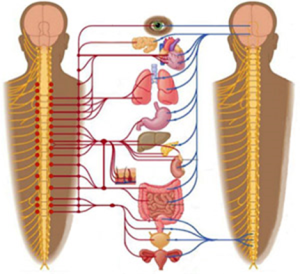
Muscles interact with metabolism. Blood transports signaling molecules. The nervous system connects distant tissues. Immune and inflammatory signaling can influence processes throughout the body.
Exercise makes this easy to understand.
You can train only your legs, but the response does not remain inside your quadriceps. Heart rate changes. Blood flow changes. Energy demand shifts. The nervous system responds, and inflammatory and hormonal signals change.
PBM research is increasingly being considered at similarly different biological levels.
Researchers have described photobiomodulation effects at molecular, cellular, tissue, and systemic levels.[1]
There is also research into remote photobiomodulation, where illuminating one area may be associated with responses in tissue that was not directly exposed to the light.[2]
The mechanisms and clinical significance of these remote responses are still being investigated. Proposed explanations include circulating signaling molecules and systemic stress-response pathways.
This creates an important distinction between localized and whole-body exposure.
Whole-body PBM does not simply expose more surface area. It brings more regions and tissue types into the treatment field at the same time.
That creates a broader biological rationale for studying whole-body PBM, without implying that it is automatically superior to localized PBM.
Red Light Mask vs Whole-Body PBM: Localized vs Large-Area Exposure
A red light mask and a whole-body PBM system may even use some of the same wavelengths.
For example, both could deliver 660 nm red light, but that does not make the exposures equivalent.
A mask may deliver that wavelength across the face. A whole-body system may deliver light across substantially larger portions of the body.
And wavelength is only one part of the PBM equation.
Photobiomodulation exposure also depends on factors such as:
Wavelength
Which wavelengths are being delivered?
Irradiance
How much optical power reaches the tissue?
Dose
How much energy is delivered over the treatment period?
Distance
How far is the light source from the body?
Treatment area
How much tissue is directly exposed?
Treatment time
How long does the exposure last?
Pulse parameters
Is the light continuous or pulsed, and how is that pulse structured?
This is why two devices that both appear to emit “red light” can represent very different PBM systems.
PBM quality is not determined by how large the device is. It depends on how the light signal is delivered.
What Does Whole-Body PBM Research Show?
Researchers have begun studying whole-body PBM separately from localized photobiomodulation.
In one randomized crossover study, 48 healthy, physically active adults received 20 minutes of whole-body PBM before repeated maximal cycling.[3]
Heart-rate variability measured the following morning was significantly higher following whole-body PBM than after placebo.
The interesting part of the study was therefore not an immediate performance boost.
It was the physiological signal observed during the recovery period.
Whole-body PBM has also been investigated in randomized controlled research involving fibromyalgia, where researchers examined outcomes including pain and quality of life following a series of whole-body PBM sessions.[5]
These studies do not show that whole-body PBM is better than localized PBM for every purpose.
They show something more useful:
Whole-body exposure is being investigated as its own PBM approach because its treatment scale differs from localized exposure.
Does More Coverage Automatically Mean More Benefits?
No.
This is an important distinction.
Exposing more of the body does not automatically mean that every biological effect will become stronger or that whole-body PBM will outperform a targeted device.
PBM follows a dose-dependent response, and outcomes can vary based on wavelength, irradiance, treatment time, protocol, target tissue, and population.
There are also many situations where localized treatment is exactly what is wanted.
If the goal is facial skin, a well-designed facial PBM device may be more practical than exposing the whole body.
If the goal involves one specific shoulder, knee, muscle group, or other region, a panel may offer the flexibility needed to concentrate the exposure there.
Whole-body PBM becomes particularly relevant when the intended scope itself is broad.
More coverage is not automatically better coverage.
The important question is whether the coverage matches the purpose.
Red Light Mask vs PBM Panel vs Whole-Body PBM
The three formats are easier to understand when they are compared by treatment scope rather than ranked from basic to advanced.
| PBM Format | Primary Strength | Typical Treatment Scope |
|---|---|---|
| Red Light Mask | Specialized facial exposure | Face |
| PBM Panel | Flexible positioning | Selected or regional areas |
| Whole-Body PBM | Large-area simultaneous exposure | Multiple body regions |
Red Light Mask
A red light therapy mask makes sense when facial PBM is the main goal.
Its strength is specialization.
The device is built around facial geometry and can be designed to control parameters such as wavelength, dose, distance, and pulse delivery within that defined area.
PBM Panel
A PBM panel provides flexibility.
Depending on the design, it can be positioned around the face, abdomen, back, shoulder, legs, muscles, or other selected regions.
For people who want to change the treatment area from session to session, that flexibility can be valuable.
Whole-Body PBM
A whole-body PBM system is designed for a different use case.
Instead of moving the light source repeatedly from one region to another, multiple regions can be exposed within one treatment environment.
That makes it particularly relevant when the desired scope includes larger muscle groups, multiple body regions, or a broader recovery and wellness routine.
Why Whole-Body PBM Is Interesting for Recovery Research
Recovery is rarely a single-tissue process.
After strenuous exercise, for example, the body coordinates changes involving muscle tissue, metabolism, circulation, autonomic nervous system activity, inflammatory signaling, and energy availability.
This is one reason large-area PBM has become interesting in recovery research.
By increasing the amount and variety of tissue included within the treatment field, whole-body PBM gives researchers a different way to investigate photobiomodulation.
At the same time, research into remote and systemic PBM responses suggests that the biological conversation may extend beyond the exact tissue directly beneath the light source.[1][2]
The question researchers are beginning to explore is therefore not simply:
Can PBM affect this one illuminated area?
It is also:
What happens when photobiomodulation is delivered across a much larger portion of an interconnected biological system?
That question remains open, and it is one of the more interesting directions in PBM research.
Why Hue Light Develops Different PBM Formats
Hue Light does not approach PBM as though one device should solve every problem.
Different treatment goals require different delivery formats.
A facial PBM device can be optimized around the face.
A professional PBM panel can provide adjustable regional exposure.
A whole-body system can be designed around large-area simultaneous exposure.
What connects these formats is not their physical size.
It is the ability to control the light signal.
This distinction is important because it shifts the question towards
“How should PBM be delivered for this particular treatment area and goal?”
Red Light Mask vs Whole-Body PBM: Which Is Better for You?
If facial skincare is your primary goal, a red light mask may be the most practical PBM format.
If you want the flexibility to work with different selected body regions, a PBM panel may make more sense.
If your goal involves large-area exposure, multiple body regions, or a broader recovery routine, whole-body PBM offers a different treatment scale.
The key is not to rank these devices from weakest to strongest.
They are different ways of delivering photobiomodulation.
A mask specializes in a defined area. A panel provides regional flexibility. Whole-body PBM expands the treatment field.
And as PBM technology continues to develop, the most meaningful differences may increasingly come not from device shape, but from how precisely wavelength, dose, treatment area, and pulse parameters are controlled.
That is ultimately a better way to evaluate any PBM device.
Not by how much red light you can see.
But by what signal is being delivered, where it is being delivered, and why.
References
- Photobiomodulation at molecular, cellular, and systemic levels.
Lasers in Medical Science. 2023.
https://pubmed.ncbi.nlm.nih.gov/37310556/ - Remote tissue conditioning — An emerging approach for inducing body-wide protection against diseases of ageing.
Ageing Research Reviews. 2017.
https://pubmed.ncbi.nlm.nih.gov/28552720/ - Whole-body photobiomodulation improves post-exercise recovery but does not affect performance or physiological response during maximal anaerobic cycling.
Lasers in Medical Science. 2023.
https://pubmed.ncbi.nlm.nih.gov/37099210/ - Mechanisms and Mitochondrial Redox Signaling in Photobiomodulation.
Photochemistry and Photobiology. 2018.
https://pubmed.ncbi.nlm.nih.gov/29164625/ - Short-Term Effects of Whole-Body Photobiomodulation on Pain, Quality of Life and Psychological Factors in a Population Suffering from Fibromyalgia: A Triple-Blinded Randomised Clinical Trial.
Pain and Therapy. 2023.
https://pubmed.ncbi.nlm.nih.gov/36369323/ - Mechanisms and applications of the anti-inflammatory effects of photobiomodulation.
AIMS Biophysics. 2017.
https://pmc.ncbi.nlm.nih.gov/articles/PMC5523874/ - Effects of photobiomodulation on multiple health outcomes: an umbrella review of randomized clinical trials.
Systematic Reviews. 2025.
https://pubmed.ncbi.nlm.nih.gov/40770824/ - Immunomodulatory effects of photobiomodulation: a comprehensive review.
Lasers in Medical Science. 2025.
https://pmc.ncbi.nlm.nih.gov/articles/PMC11991943/