Why researchers are looking beyond the brain—and why whole-body PBM is entering the conversation
“The first visible symptom may not be the first change.”
A hand begins to shake while holding a coffee cup. Buttons take longer to fasten, or one arm stops swinging as naturally while walking. For many people, this is when Parkinson’s disease first becomes visible — and increasingly, when Parkinson’s disease PBM research enters the conversation.
But after a diagnosis, earlier changes sometimes come back to mind. Constipation that had lasted for years. Food that no longer smells quite as strong. Talking, kicking, or moving suddenly during dreams.
At the time, none of it seemed connected.
Now researchers are asking whether those quieter changes may sometimes begin long before the movement symptoms most people associate with Parkinson’s.
Prodromal Parkinson’s Symptoms: Up to 20 Years Earlier?
Constipation has been reported as early as 20 years before movement symptoms in some people with Parkinson’s disease. [1] It is also extremely common and means very little on its own.
The Clues People May Only Connect Later
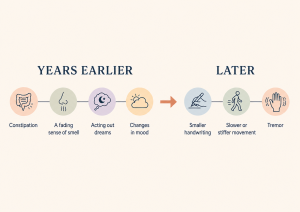
YEARS EARLIER Constipation → A fading sense of smell → Acting out dreams → Changes in mood
LATER Smaller handwriting → Slower or stiffer movement → Tremor
The order and timing are different for everyone. [1,2]
These earlier symptoms are easy to overlook because they have so many ordinary explanations. Constipation may come from diet, medication, dehydration, or reduced movement. Poor sleep may be blamed on stress. A fading sense of smell may not seem important enough to mention.
The surprising part is not that one of these symptoms can “predict” Parkinson’s. It cannot. It is that a condition known for movement may have been affecting other parts of daily life first.
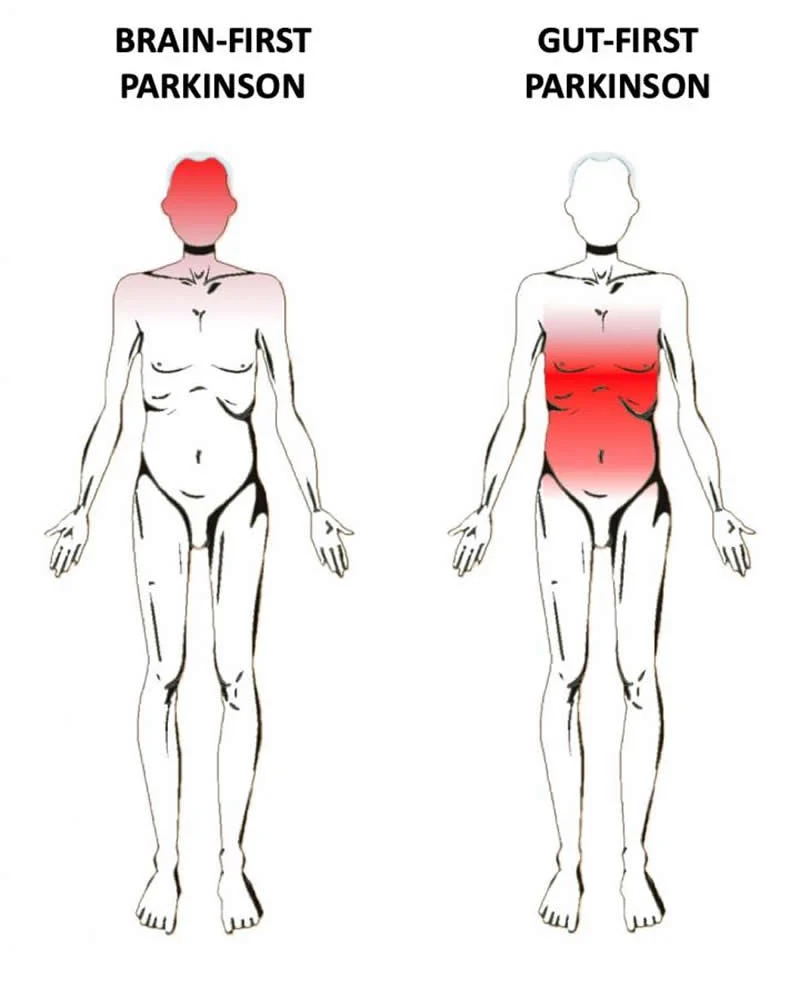
The Gut-Brain Axis and Parkinson’s: Why Is the Gut Part of a Brain Conversation?
The gut and brain are constantly exchanging information through nerves, immune signals, and the bloodstream. Researchers call this the gut-brain axis.
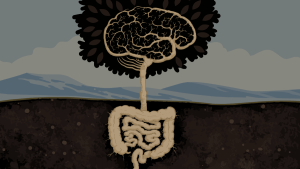
Parkinson’s disease is also linked to the abnormal buildup of a protein called alpha-synuclein. One area of research is examining whether changes involving this protein may begin around the digestive system in some people before becoming more noticeable in the brain. [3]
There is still no single path that explains every case of Parkinson’s. But the gut research has already changed the question. Instead of looking only at where the clearest symptoms appear, researchers are also looking at the wider systems connected to them.
“A tremor may be when Parkinson’s becomes visible. It may not be when the changes began.”
What Does This Change About PBM? The Case for Whole-Body PBM
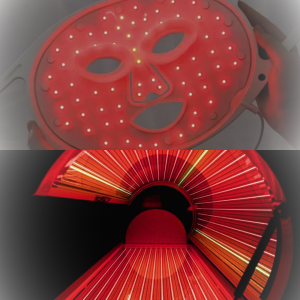
Most photobiomodulation, or PBM, is targeted. Red or near-infrared light may be directed toward the head, a joint, a muscle, or another specific area. The focus is the tissue directly receiving the light.
But Parkinson’s research is making the picture wider. If the gut, circulation, immune signals, nervous system, and brain are communicating with one another, should light-based research always focus on only one location?
Interestingly, some early Parkinson’s PBM research has already moved beyond the head. Small human studies have explored light applied to areas such as the abdomen and neck, while preclinical studies have compared PBM directed at the head with PBM directed toward other parts of the body. [4,5]
That leads naturally to a broader approach: whole-body PBM.
Targeted PBM vs. Whole-Body PBM: Different Questions, Not Just More Light
| Targeted PBM | Whole-Body PBM | |
|---|---|---|
| Approach | Light is focused on one area | A much larger area is exposed at once |
| The question | What happens in the tissue receiving the light? | What happens when we approach the body as a connected system? |
Whole-body PBM is not simply targeted PBM with “more light.” The difference is the perspective.
PBM research often looks at how red and near-infrared wavelengths interact with mitochondrial activity, cellular signaling, circulation, and inflammatory responses. [6] With a targeted device, those questions begin in one location. With whole-body PBM, researchers can explore a broader exposure involving multiple tissues at the same time.
That wider view feels especially relevant here. Parkinson’s may be recognized through movement, but the research now reaches into digestion, sleep, smell, circulation, and the nervous system. Whole-body PBM reflects the same shift: looking beyond the place where the symptom appears and toward the system surrounding it.
Looking Beyond the Head
For a family, Parkinson’s may seem to begin with a shaking cup or a change in someone’s walk. Research tells a more complicated story.
The body may have been whispering much earlier, through digestion, smell, or sleep. Those symptoms are not a diagnosis, but they remind us that the brain never works by itself.
That is why whole-body PBM is an interesting direction. Targeted PBM asks what light may do in one specific area. Whole-body PBM asks the larger question: What changes when we stop looking at one body part and begin looking at the connected system?
That question is still being explored, but it may be much closer to how the body actually works. Where Parkinson’s disease PBM research goes next is something worth watching closely.
Exploring Whole-Body PBM
Research Mentioned
- Prevalence of Prodromal Symptoms of Parkinson’s Disease in the Late Middle-Aged Population
- Parkinson’s Foundation: Non-Movement Symptoms
- The Gut–Brain Axis in Early Parkinson’s Disease
- Remote Photobiomodulation Targeted at the Abdomen or Legs in Experimental Parkinson’s Disease
- Remote Photobiomodulation Treatment for the Clinical Signs of Parkinson’s Disease
- The Molecular Mechanisms of Action of Photobiomodulation on Neurodegenerative Diseases
This article introduces emerging research and overseas approaches for general informational purposes. It does not make a claim that whole-body PBM treats Parkinson’s disease.