![[In-Depth Medical Column] The Alchemy of Light: From Alpine Sunlight to the Pinnacle of Quantum Medicine — The Whole-Body PBM (Photobiomodulation) System](https://hue-light.com/wp-content/uploads/2026/04/product-B15-23.jpg)
The Return of Humanity’s Oldest Medicine: Light
The whole-body PBM system did not appear out of nowhere.
For much of medical history, healing was built around matter.
Which herb should be brewed?
Which compound should be extracted?
Which chemical should be injected into the bloodstream?
That is the version of medicine most people know today.
But long before modern pharmaceuticals, long before laboratories and synthetic compounds, humans had already recognized one of the most basic forces connected to life.
Light.
![[In-Depth Medical Column] The Alchemy of Light: From Alpine Sunlight to the Pinnacle of Quantum Medicine — The Whole-Body PBM (Photobiomodulation) System](data:image/svg+xml,%3Csvg%20xmlns='http://www.w3.org/2000/svg'%20width='355'%20height='251'%20viewBox='0%200%20355%20251'%3E%3C/svg%3E)
Auguste Rollier & Heliotherapy — Europe’s Pioneer of Solar Medicine
![[In-Depth Medical Column] The Alchemy of Light: From Alpine Sunlight to the Pinnacle of Quantum Medicine — The Whole-Body PBM (Photobiomodulation) System](https://hue-light.com/wp-content/uploads/2026/04/product-B15-16-300x212.jpg)
Sunlight shaped sleep, immunity, mood, growth, and recovery long before we had the language to explain why. Ancient civilizations in Egypt and Greece used heliotherapy, or sunlight therapy, as part of healing practices. What began as instinct and observation is now being revisited through a modern scientific lens.
Today, that old relationship between light and the body is being rebuilt through photobiomodulation, or PBM.
In other words, what ancient medicine sensed intuitively is now being studied through molecular biology, mitochondria, and cellular signaling.
Niels Finsen: When Light First Won the Nobel Prize
![[In-Depth Medical Column] The Alchemy of Light: From Alpine Sunlight to the Pinnacle of Quantum Medicine — The Whole-Body PBM (Photobiomodulation) System](data:image/svg+xml,%3Csvg%20xmlns='http://www.w3.org/2000/svg'%20width='190'%20height='305'%20viewBox='0%200%20190%20305'%3E%3C/svg%3E)
![[In-Depth Medical Column] The Alchemy of Light: From Alpine Sunlight to the Pinnacle of Quantum Medicine — The Whole-Body PBM (Photobiomodulation) System](data:image/svg+xml,%3Csvg%20xmlns='http://www.w3.org/2000/svg'%20width='550'%20height='304'%20viewBox='0%200%20550%20304'%3E%3C/svg%3E)
The Phototherapy Device Developed by Dr. Finsen
![[In-Depth Medical Column] The Alchemy of Light: From Alpine Sunlight to the Pinnacle of Quantum Medicine — The Whole-Body PBM (Photobiomodulation) System](https://hue-light.com/wp-content/uploads/2026/04/스크린샷-2026-04-06-오후-1.41.45-187x300.png)
![[In-Depth Medical Column] The Alchemy of Light: From Alpine Sunlight to the Pinnacle of Quantum Medicine — The Whole-Body PBM (Photobiomodulation) System](https://hue-light.com/wp-content/uploads/2026/04/n닐스핀센이개발한광치료기구-1-300x166.jpg)
The modern history of light therapy begins with Danish physician Niels Finsen.
In 1903, Finsen received the Nobel Prize in Physiology or Medicine for his pioneering work using light to treat disease. At the time, Europe was struggling with lupus vulgaris, a severe form of cutaneous tuberculosis that left many patients with disfiguring skin lesions.
Finsen realized that certain forms of light, especially concentrated ultraviolet light, could have a powerful biological effect.
He developed a dedicated phototherapy device and used it to treat patients who had very limited options at the time. His work became one of the first major scientific proofs that light could be more than warmth, brightness, or comfort.
Light could be a therapeutic tool.
It was a turning point in medicine.
Auguste Rollier: Alpine Sunlight and the Era of Heliotherapy
![[In-Depth Medical Column] The Alchemy of Light: From Alpine Sunlight to the Pinnacle of Quantum Medicine — The Whole-Body PBM (Photobiomodulation) System](data:image/svg+xml,%3Csvg%20xmlns='http://www.w3.org/2000/svg'%20width='368'%20height='230'%20viewBox='0%200%20368%20230'%3E%3C/svg%3E)
![[In-Depth Medical Column] The Alchemy of Light: From Alpine Sunlight to the Pinnacle of Quantum Medicine — The Whole-Body PBM (Photobiomodulation) System](data:image/svg+xml,%3Csvg%20xmlns='http://www.w3.org/2000/svg'%20width='368'%20height='229'%20viewBox='0%200%20368%20229'%3E%3C/svg%3E)
Auguste Rollier & Heliotherapy — Europe’s Pioneer of Solar Medicine
![[In-Depth Medical Column] The Alchemy of Light: From Alpine Sunlight to the Pinnacle of Quantum Medicine — The Whole-Body PBM (Photobiomodulation) System](https://hue-light.com/wp-content/uploads/2026/04/product-B15-19-1-300x187.jpg)
![[In-Depth Medical Column] The Alchemy of Light: From Alpine Sunlight to the Pinnacle of Quantum Medicine — The Whole-Body PBM (Photobiomodulation) System](https://hue-light.com/wp-content/uploads/2026/04/product-B15-20-300x187.jpg)
If Finsen showed how light could be used in a targeted way, Swiss physician Auguste Rollier took the idea in a broader direction.
In the late 19th and early 20th centuries, tuberculosis was one of Europe’s most feared diseases. Antibiotics did not yet exist, and many patients were sent away to mountain sanatoriums with little certainty of recovery.
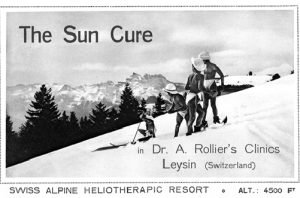
In 1903, Rollier established a solar sanatorium in Leysin, high in the Swiss Alps. There, patients were exposed to carefully managed mountain sunlight as part of a treatment approach he called heliotherapy.
The images from that era are striking.
Patients who had been pale, weak, and severely ill gradually bronzed under the Alpine sun. In some cases, inflammation improved. Skeletal tuberculosis showed signs of healing. The body, exposed to light, seemed to regain a kind of internal strength.
Rollier saw sunlight not only as a local treatment, but as something that could influence the body as a whole.
That idea matters.
Because even though the tools have changed, the question remains the same:
Can light support the body’s own ability to recover?
John Harvey Kellogg: From Sunlight to the First Light Chamber
![[In-Depth Medical Column] The Alchemy of Light: From Alpine Sunlight to the Pinnacle of Quantum Medicine — The Whole-Body PBM (Photobiomodulation) System](data:image/svg+xml,%3Csvg%20xmlns='http://www.w3.org/2000/svg'%20width='275'%20height='220'%20viewBox='0%200%20275%20220'%3E%3C/svg%3E)
![[In-Depth Medical Column] The Alchemy of Light: From Alpine Sunlight to the Pinnacle of Quantum Medicine — The Whole-Body PBM (Photobiomodulation) System](data:image/svg+xml,%3Csvg%20xmlns='http://www.w3.org/2000/svg'%20width='274'%20height='219'%20viewBox='0%200%20274%20219'%3E%3C/svg%3E)
![[In-Depth Medical Column] The Alchemy of Light: From Alpine Sunlight to the Pinnacle of Quantum Medicine — The Whole-Body PBM (Photobiomodulation) System](data:image/svg+xml,%3Csvg%20xmlns='http://www.w3.org/2000/svg'%20width='172'%20height='219'%20viewBox='0%200%20172%20219'%3E%3C/svg%3E)
Dr. John Harvey Kellogg — Pioneer of the Incandescent Light Bath
![[In-Depth Medical Column] The Alchemy of Light: From Alpine Sunlight to the Pinnacle of Quantum Medicine — The Whole-Body PBM (Photobiomodulation) System](https://hue-light.com/wp-content/uploads/2026/04/product-B15-22-300x240.jpg)
![[In-Depth Medical Column] The Alchemy of Light: From Alpine Sunlight to the Pinnacle of Quantum Medicine — The Whole-Body PBM (Photobiomodulation) System](https://hue-light.com/wp-content/uploads/2026/04/product-B15-23-300x240.jpg)
![[In-Depth Medical Column] The Alchemy of Light: From Alpine Sunlight to the Pinnacle of Quantum Medicine — The Whole-Body PBM (Photobiomodulation) System](https://hue-light.com/wp-content/uploads/2026/04/product-B15-26-235x300.jpg)
The problem with sunlight was obvious.
It depended on the weather.
It depended on the season.
It depended on geography.
Doctors wanted something more controllable.
After Edison’s invention of the incandescent bulb, that possibility began to take shape. One of the people who pushed it forward was Dr. John Harvey Kellogg.
Kellogg believed that radiant energy from incandescent bulbs could influence the body more deeply than surface warmth alone. He designed what became known as the incandescent light bath, a chamber lined with bulbs that surrounded the body with light and heat.
It became widely known among European royalty, aristocrats, and health seekers of the time.
But beyond its popularity, Kellogg’s chamber introduced an important medical idea: light did not have to be applied only to one small area.
It could be delivered to the whole body.
That shift, from localized light exposure to whole-body light exposure, became one of the early conceptual ancestors of today’s whole-body PBM system.
Kellogg himself lived to 91, a remarkable age for his era, and remained closely associated with the belief that lifestyle, environment, and physical therapies could shape long-term health.
From Sunlight to Mitochondria: Why PBM Changed the Conversation
Modern medicine now faces challenges that are very different from those of Finsen, Rollier, and Kellogg.
Cancer.
Neurodegenerative disease.
Chronic inflammation.
Metabolic dysfunction.
Long-term fatigue.
These conditions are not always easy to explain by looking at one organ alone.
Increasingly, researchers are looking deeper, toward the cell’s energy system. At the center of that system are the mitochondria, often described as the power plants of the cell.
This is where PBM becomes especially important.
The key mechanism of PBM involves an enzyme inside the mitochondria called cytochrome c oxidase. When cells are exposed to specific wavelengths of red and near-infrared light, generally within the 600–1,200 nm range, cytochrome c oxidase can absorb that light energy and trigger biological responses inside the cell.
Those responses may include:
Increased ATP production, supporting cellular energy supply.
Nitric oxide release, which can help blood vessels dilate and support circulation.
Activation of cellular repair signaling, which is involved in tissue recovery and regeneration.
This is not simple heat stimulation.
PBM works through light-driven cellular signaling. Instead of burning or damaging tissue, it uses specific wavelengths of light to interact with the cell’s own biological machinery.
That is why photobiomodulation has become one of the most closely watched areas in light-based medicine.
The Pinnacle of Evolution: The Hue Light Whole-Body PBM System

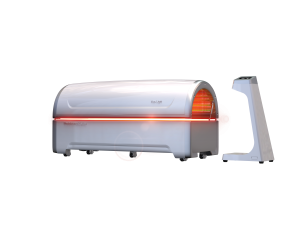
The lineage that runs from the alpine sun to Kellogg’s chamber has now arrived at its most advanced form through
Hue Light’s engineering: the Whole-Body PBM system.
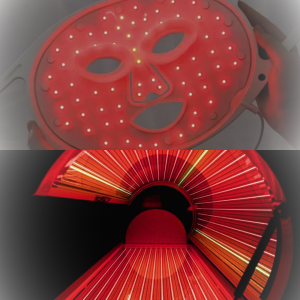
Simultaneous full-body irradiation From the brain to the tips of the toes, trillions of cells are activated simultaneously, restoring the body’s homeostasis in a single session. The systemic effect is categorically beyond anything localized irradiation can achieve.
Gut-Brain Axis and Glymphatic System activation: By activating the glymphatic system, the brain’s waste-clearance network, Hue Light’s whole-body PBM offers a groundbreaking approach to the prevention and management of neurodegenerative conditions such as Alzheimer’s and Parkinson’s disease.
Non-invasive safety: Without the hepatotoxicity of pharmaceuticals or the risks of surgery,
whole-body PBM restores the body’s electrical and biochemical balance through the most natural force in existence: light.
Closing: A Return to Light
Medical history is turning full circle, back toward its origins.
The alpine sunlight that once saved dying patients now enters our daily lives through the lens of cutting-edge photonic technology.
In an age of chronic disease, we can no longer rely on powerful external pharmaceuticals alone.
We need a primer for energy, something that awakens the dormant cells within us and helps a broken system repair itself.
Light is the source of life. And it may be the most perfect medicine we have ever known.
The great journey, from Finsen to Rollier to Kellogg, has now reached its zenith in whole-body PBM, casting new light on humanity’s long struggle with chronic disease.
Want to learn more about the Whole-Body PBM System? Explore Hue Light’s full product information.